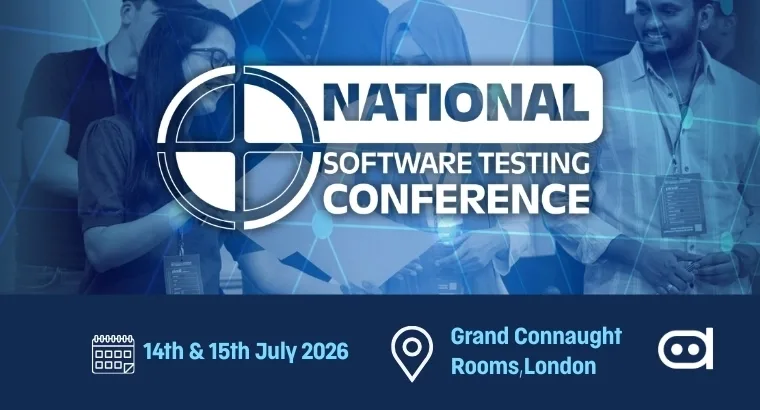
There is a quiet but consequential shift happening inside every major technology organisation right now — and it has almost nothing to do with building AI. It has everything to do with trusting it. Software testing and quality assurance, long treated as the unglamorous back-end of product development, is suddenly at the centre of one of the most urgent conversations in enterprise technology. The National Software Testing Conference (NSTC) 2026, scheduled for July 14–15 at the Grand Connaught Rooms in London, is arriving at exactly the right moment to lead that conversation.
The Problem Nobody Is Talking About Loudly Enough
As organisations rush to embed AI into their products, workflows, and customer experiences, they are discovering a deeply uncomfortable truth: AI systems are extraordinarily difficult to test using traditional methods. A conventional software function either works or it doesn’t. An AI model, by contrast, produces probabilistic outputs — meaning it might work perfectly nine hundred times and fail in dangerous ways on the thousandth attempt.
This is not a theoretical risk. It is the lived reality for quality assurance teams at banks, hospitals, retailers, and government agencies deploying AI today. The tools, frameworks, and mental models that testing professionals built their careers on were simply not designed for this world. That gap is what NSTC 2026 is directly addressing.
Why This Conference Reflects a Larger Industry Inflection Point
What makes NSTC particularly interesting as a signal is its attendee composition. Seventy percent of delegates at previous editions held senior leadership roles — CTOs, QA Directors, Vice Presidents, DevOps Leads. This is not a gathering of junior engineers exchanging tutorials. It is where institutional decision-making about testing strategy actually happens.
When senior leaders from JP Morgan, global consultancies, and technology firms converge to discuss AI in quality engineering, accessibility testing, and security validation, you are watching an industry actively renegotiating its own professional standards. That kind of peer-driven recalibration is how enterprise norms shift — quietly, conference by conference, until they become policy.
What the Agenda Tells Us About AI’s Real Enterprise Challenges
The NSTC 2026 programme is structured around the most pressure-tested pain points in modern quality engineering: AI’s role in testing automation, accessibility compliance, security vulnerabilities introduced by AI-generated code, and contemporary testing methodologies that can keep pace with accelerated delivery cycles.
That last point deserves attention. The rise of AI-assisted code generation tools means developers can produce code faster than ever before. But speed without quality assurance is just accelerated failure. Testing teams are being asked to validate more output, in less time, with higher stakes — while simultaneously learning entirely new AI-specific testing disciplines. It is an almost impossible mandate without new approaches.
The Accessibility and Security Dimensions Most Coverage Misses
Two threads in the NSTC agenda stand out as underreported in mainstream AI coverage: accessibility and security. AI-generated interfaces and content can inadvertently exclude users with disabilities if accessibility is not baked into the testing process from the start. This is both an ethical issue and, in many jurisdictions, a legal one.
On the security side, AI-generated code introduces a category of vulnerability that traditional static analysis tools struggle to catch. When a developer writes code manually, their intent is relatively transparent. When an AI model generates code, the logic can be opaque — and attackers are already learning to exploit that opacity. Quality engineering teams are now, effectively, on the front line of AI security.
Key Facts: NSTC 2026 At a Glance
| Detail | Information |
|---|---|
| Event Dates | July 14–15, 2026 |
| Location | Grand Connaught Rooms, London, UK |
| Senior Leader Attendance | 70% (CTOs, VPs, QA Directors, DevOps Leads) |
| Sponsor Reach | 50,000+ industry professionals via marketing |
| Key Themes | AI in testing, accessibility, security, modern QA methods |
| Industries Represented | Finance, healthcare, retail, energy, media, education |
| Gold Partner | Expleo (AI engineering, hyperautomation, cybersecurity) |
| Silver Partner | Perforce (continuous testing, risk reduction tools) |
What the Partner Ecosystem Reveals About Market Direction
The sponsorship structure of a conference is often more revealing than its agenda. Expleo, the Gold Partner at NSTC 2026, is a global engineering and consulting firm with explicit practices in AI engineering, hyperautomation, and cybersecurity. Their presence signals that the market for AI-integrated quality assurance services is being actively commercialised — not just discussed.
Perforce, the Silver Partner, provides continuous testing infrastructure designed to reduce release risk without slowing delivery. The combination of a strategic consulting partner and a tooling infrastructure partner at the same event is a blueprint for how enterprise AI adoption actually works: strategy and tooling must evolve together, or neither delivers value.
The Talent and Skills Gap Underneath the Technology Story
Perhaps the most important undercurrent at events like NSTC is one that rarely makes headlines: the severe shortage of quality engineering professionals who understand both traditional testing discipline and AI-specific validation techniques. These two skill sets have historically lived in separate professional worlds.
Think of it like this — it is the difference between a building inspector trained on concrete and steel suddenly being asked to certify structures made from a material that behaves differently depending on the weather. The principles of good inspection still apply, but the instruments, the standards, and the judgment calls all need updating. That retraining is happening, imperfectly and urgently, across the industry right now.
What the Next 12–24 Months Will Demand From Testing Professionals
Over the next two years, I expect we will see quality assurance evolve from a supporting function into a genuine strategic differentiator. Organisations that invest in AI-fluent testing teams will ship more reliable products, attract greater user trust, and face fewer regulatory challenges as AI governance frameworks tighten globally. Those that treat QA as an afterthought in their AI deployments will encounter the consequences in the most public and costly ways.
Events like NSTC are not just professional development opportunities — they are early indicators of where enterprise priorities are shifting before that shift becomes obvious in headlines. If you work in technology, product development, or organisational leadership, what happens in that room in London this July is well worth understanding, even from a distance.
If you want to understand where AI deployment either succeeds or quietly breaks down, start paying attention to the people responsible for testing it. The future of trustworthy AI runs directly through the quality engineering community — and they are already having the conversations the rest of us need to catch up on. I would genuinely encourage anyone working at the intersection of AI and enterprise technology to explore what NSTC 2026 has to offer, whether as an attendee, a sponsor, or simply a curious observer of where this field is heading.