
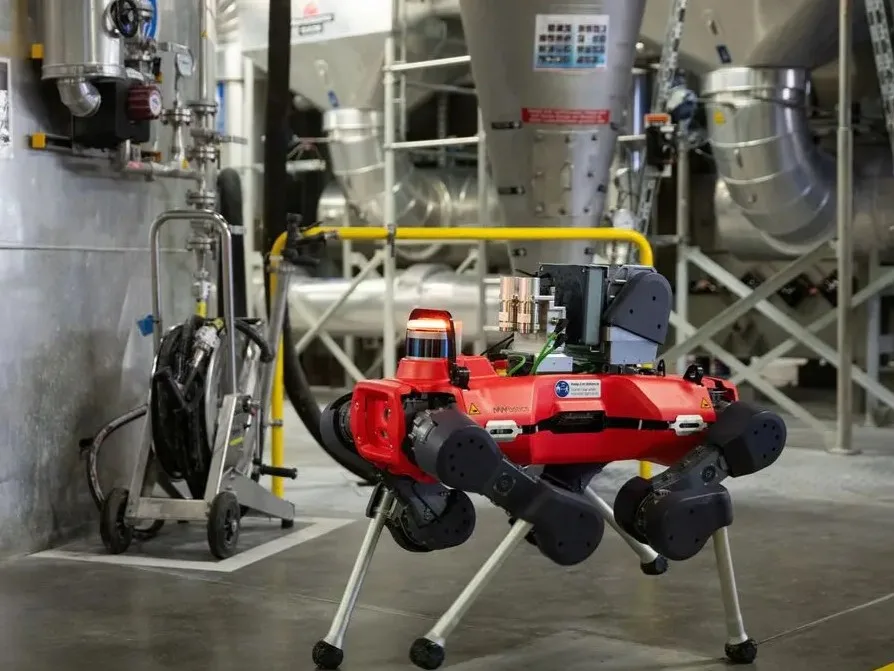
There is a quiet but significant shift happening on the floors of chemical plants, offshore rigs, and heavy manufacturing facilities — and it has four legs. The partnership between SAP, the enterprise software giant, and ANYbotics, the Swiss maker of autonomous quadruped robots, represents something more important than a hardware upgrade. It signals that physical AI — the kind that moves through the real world, gathers data, and triggers business decisions — is finally being wired directly into the systems that run global industry.
What “Physical AI” Actually Means — And Why It’s Different
Most people think of AI as something that lives in a server or a chatbot. Physical AI is the next frontier: artificial intelligence embedded in machines that interact with the physical world. ANYbotics’ four-legged robots don’t just walk around a facility — they listen, see, and sense their environment through thermal, acoustic, and visual sensors.
What makes this partnership genuinely interesting is not the robot itself. It’s what happens with the data it collects. By connecting directly to SAP’s enterprise resource planning (ERP) backend, the robot becomes a mobile data-gathering node inside an industrial network — not a standalone gadget, but an integrated part of how a company manages its assets and operations.
The Inspection Problem That’s Been Quietly Costing Industry Billions
Routine inspection in heavy industry is expensive, inconsistent, and dangerous. Human inspectors get tired. Plants are enormous. Hazardous zones carry real safety risks. And yet, the cost of missing a failing pump or an overheating motor at a refinery or chemical plant can run into millions before a machine is even taken offline.
I think of it like this: imagine relying on a tired person with a clipboard to walk miles of pipe every day, in extreme heat or cold, and trusting them to catch every subtle anomaly. Now imagine replacing that person with a machine that never gets tired, never skips a section, and never has a bad day. That’s the basic promise — but the real value comes from what happens after the robot notices something wrong.
Closing the Gap Between Discovery and Action
In traditional industrial settings, finding a problem and logging a work order are two separate, often disconnected events. A technician hears an irregular sound from a compressor, scribbles a note, and enters it into a system hours later. By the time a replacement part gets approved and delivered, the equipment may already be damaged beyond quick repair.
The SAP-ANYbotics integration collapses that gap entirely. When the robot’s onboard AI detects an irregular motor frequency, it doesn’t just flag a warning on a separate screen. Through direct API connections, it tells SAP’s asset management module immediately. The system then checks spare parts availability, calculates potential downtime costs, and schedules an engineer — all without a human initiating any of those steps.
This is what enterprise automation looks like when it matures. Not replacing workers with robots, but replacing manual reporting chains with intelligent, real-time information flows.
The Infrastructure Challenges Nobody Talks About Enough
Deploying robots in heavy industry is fundamentally different from rolling out software in an office. Factories are physically hostile environments for wireless communication — thick concrete walls, metal scaffolding, and electromagnetic interference make standard Wi-Fi unreliable. That’s a serious problem when your robot is trying to stream thermal imaging data in real time.
The solution involves two key technologies working together: edge computing and private 5G networks. Rather than sending every frame of high-definition sensor data to the cloud, the robot processes most of it locally, onboard. It only transmits the essential conclusion — the specific fault, its location, its severity — back to SAP. This dramatically reduces bandwidth demand while keeping response times fast.
Private 5G networks handle the connectivity layer. Unlike consumer Wi-Fi, private 5G can blanket a sprawling industrial facility with reliable, high-speed coverage. It also creates a closed network environment, which matters enormously for security.
Security: The Risk That Comes With Every Roaming Robot
A four-legged robot equipped with cameras, microphones, and thermal sensors is, in security terms, a roaming vulnerability. If compromised, it could expose sensitive operational data, disrupt maintenance workflows, or worse — provide access to the ERP systems it’s connected to. These are not theoretical risks in an era of sophisticated industrial cyberattacks.
Serious deployments address this with zero-trust network architecture — a security model that assumes no device or user is trustworthy by default and continuously verifies identity at every step. The robot’s access to SAP modules is tightly scoped. If it’s compromised, the system is designed to immediately isolate it. Security here is not an afterthought; it’s a structural requirement.
Key Facts: SAP and ANYbotics Industrial AI Integration
| Feature | Detail |
|---|---|
| Robot Type | ANYbotics quadruped (four-legged) autonomous robot |
| Sensors Carried | Thermal, acoustic, visual (camera), lidar |
| Enterprise Integration | Direct API connection to SAP ERP and asset management modules |
| Data Processing Model | Edge computing (onboard) + selective cloud transmission |
| Connectivity Solution | Private 5G networks for industrial facilities |
| Security Architecture | Zero-trust network protocols, scoped SAP access |
| Target Industries | Chemical plants, offshore rigs, heavy manufacturing |
| Key Benefit | Eliminates reporting lag between fault detection and maintenance action |
Where This Fits in the Broader Arc of Agentic AI
This development belongs to a larger story about agentic AI — systems that don’t just generate outputs but take autonomous actions in response to real-world conditions. The SAP-ANYbotics integration is one of the clearest real-world examples of this trend moving from enterprise software into physical infrastructure.
It also reflects an important maturation in how companies think about AI deployment. Early enterprise AI was largely about dashboards, predictions, and recommendations that humans still had to act on. What’s emerging now is a closed loop: sense, decide, act, and record — without waiting for a human at each step. That’s a meaningful shift in how industrial operations will be designed going forward.
What the Next 12–24 Months Will Likely Bring
If this integration proves reliable at scale — and early signals suggest it will — expect two things to happen quickly. First, other ERP providers will accelerate their own physical AI partnerships. SAP’s move here creates competitive pressure across the entire enterprise software landscape. Second, the industries deploying these systems will begin pushing robots into progressively more complex inspection tasks: confined spaces, underwater infrastructure, high-voltage environments.
The deeper shift is cognitive. Industrial facilities that adopt this model will start treating physical space as a data layer — something to be continuously read, interpreted, and responded to by software. That changes not just maintenance workflows but how entire plants are designed, staffed, and managed.
If you work in industrial operations, enterprise technology, or AI policy, this development deserves your full attention. The gap between physical and digital infrastructure is closing faster than most organizations have planned for — and the companies building their workflows around that convergence now will have a significant head start. I’d encourage you to explore related pieces on agentic AI in enterprise settings and the rise of edge computing as infrastructure — both threads run directly through what SAP and ANYbotics are building together.