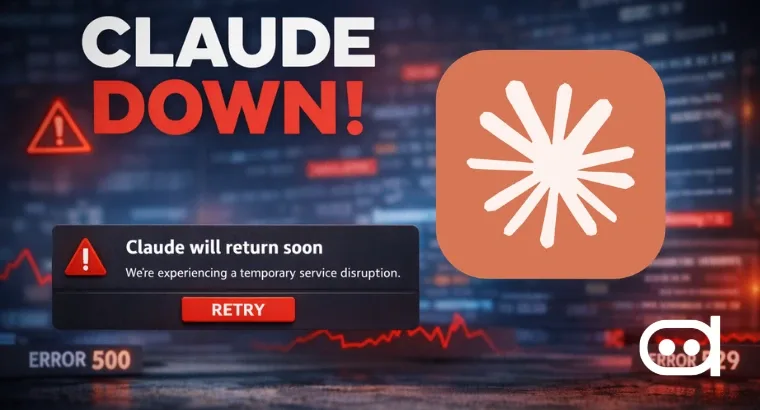
When Claude AI went dark for tens of thousands of users across two consecutive days in early March 2026, it wasn’t just a technical inconvenience — it was a signal flare about how fragile the infrastructure beneath our AI-dependent world actually is. The Claude AI outage, confirmed by Anthropic itself, exposed something the industry rarely talks about openly: as AI platforms scale to millions of users, the gap between capability and reliability is widening faster than most companies can manage.
I’ve been tracking enterprise AI adoption for several years now, and what struck me most about this incident wasn’t the downtime itself. It was the timing, the scope, and the broader context in which it happened. This wasn’t a startup stumbling. This was one of the most well-funded, technically sophisticated AI labs in the world losing control of its flagship product — twice in 48 hours.
What Actually Happened During the Claude Outage
On March 2, 2026, users began flooding Downdetector with reports of HTTP 500 and 529 errors, login loops, sluggish responses, and flat-out denial of service on both Claude’s web app and mobile platform. Anthropic eventually restored service — but the reprieve was short-lived. By the early hours of March 3, a second wave of issues hit, this time affecting claude.ai, the API platform, CoWork integrations, and Claude Code simultaneously.
Anthropic’s status page confirmed elevated error rates across all these surfaces. With over 2,000 users actively reporting problems on Downdetector at the peak, this wasn’t a regional blip. It was a system-wide strain event. As of the time of writing, no formal resolution timeline had been publicly confirmed.
Why Two-Day Outages Are Different From One-Day Outages
There’s a meaningful difference between a system going down and a system going down again after you thought you’d fixed it. The former is a reliability problem. The latter suggests something deeper — either the root cause wasn’t fully identified, the fix introduced a new failure point, or the infrastructure itself is running at a level of load it wasn’t designed to handle.
Think of it like a highway that keeps jamming at the same interchange. Clearing one traffic jam doesn’t solve the problem if the on-ramp design is fundamentally inadequate for current volumes. Anthropic’s engineering team almost certainly understands this, which is why the second day of disruption is the more alarming data point here.
The Infrastructure Reality Behind AI at Scale
What most users don’t see when they type a prompt into Claude is the staggering complexity operating beneath the surface. Large language model inference — the process of generating a response — is computationally intensive in ways that differ fundamentally from serving a webpage or streaming a video. Each query requires GPU clusters to perform billions of calculations in real time, often across distributed data centers.
When demand spikes unexpectedly, or when a software update interacts badly with underlying hardware configurations, cascading failures become possible in ways that are genuinely difficult to predict. The fact that Claude Code and the API platform were both affected alongside the consumer product suggests this wasn’t a front-end issue. It was something deeper in the stack.
Claude’s Reliability Compared to Competing Platforms
| Platform | Recent Outage History | Primary User Base | Enterprise SLA Offered |
|---|---|---|---|
| Claude (Anthropic) | 2-day consecutive outage, March 2026 | Developers, enterprise, general users | Yes, via API tier |
| ChatGPT (OpenAI) | Multiple outages in 2024–2025 | General consumers, enterprise | Yes, via enterprise plan |
| Gemini (Google) | Isolated incidents, lower public reporting | Google ecosystem users | Yes, via Google Cloud |
| Grok (xAI) | Limited public data | X platform users | Limited |
The Ethical Dimension Running Alongside the Technical One
Here’s where the story gets genuinely layered. While its servers were struggling, Anthropic was simultaneously making headlines for a very different reason. The company was reportedly blacklisted by the Trump administration after refusing to grant unrestricted government access to its technology — citing concerns around mass surveillance capabilities and autonomous weapons development.
That refusal has earned Anthropic significant public goodwill. Users in the United States pushed Claude to the top of the App Store charts, and the company has received vocal support from employees at both OpenAI and Google DeepMind in connection with a Department of Defense-related lawsuit. It’s a remarkable moment: a company being rewarded commercially for saying no to a government.
This matters beyond the ethics headline. It shapes the kind of trust relationship Anthropic is building with its user base — one grounded in stated principles rather than just product performance. But that trust will only hold if the product itself proves reliable over time.
What This Signals for Enterprise AI Adoption
For enterprise teams that have embedded Claude into their workflows — legal document review, code generation, customer support automation — a two-day outage isn’t a minor frustration. It’s a business continuity event. Any CTO evaluating AI vendors right now is quietly asking a question that rarely appears in product demos: what happens when it goes down?
The incident highlights a growing pressure point in enterprise AI procurement. Organizations are being sold on capability — benchmarks, context windows, reasoning scores — but the conversations about uptime guarantees, redundancy architecture, and failover options are still far too rare. This outage will accelerate those conversations significantly.
The Broader Pattern: AI Infrastructure Is the New Bottleneck
Zoom out, and what you see is an industry-wide pattern. The race to ship more capable models has consistently outpaced the race to build reliable infrastructure to serve them. This isn’t a criticism unique to Anthropic. OpenAI has faced similar strain events. The difference now is that these platforms are no longer used casually — they are embedded in critical business workflows, professional tools, and daily productivity systems for millions of people globally.
The next 12 to 24 months will almost certainly see AI companies invest heavily in what I’d call “reliability infrastructure” — distributed serving architectures, regional redundancy, real-time failover systems, and transparent status communication. The companies that figure this out fastest won’t just win on model quality. They’ll win on trust. And in enterprise AI, trust is the product.
What Comes Next for Anthropic — and for You
If you’re an individual user, the practical takeaway is straightforward: don’t build single-point dependencies on any AI platform, no matter how polished it looks. Have a backup workflow. Know which alternative tool you’d switch to if your primary platform goes dark at a critical moment.
If you’re evaluating AI tools for your organization, start asking harder questions about infrastructure guarantees before you sign. Request uptime SLA documentation. Ask what happened during the March 2026 outage and what architectural changes were made in response. A vendor’s answer to that question will tell you more about their reliability culture than any benchmark ever could.
I’ll be watching how Anthropic responds to this moment — not just technically, but communicatively. The companies that turn infrastructure crises into trust-building opportunities by being transparent, accountable, and specific about their fixes tend to emerge stronger. The ones that quietly patch and move on leave a lingering doubt. Which path Anthropic chooses will say a great deal about the kind of AI company it intends to be.