
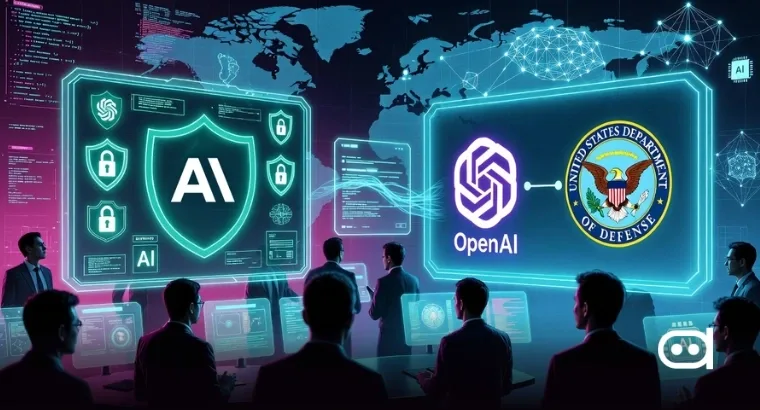
There is a quiet standoff happening right now that will likely define the moral architecture of AI for the next decade. Anthropic, one of the most influential AI safety companies in the world, is holding a line that its biggest rival just erased — and the consequences reach far beyond Silicon Valley boardrooms.
The Company Built on a Promise It’s Now Being Asked to Break
Anthropic was founded in 2021 by Dario and Daniela Amodei, along with a cohort of researchers who left OpenAI over concerns that the pace of development was outrunning the discipline of safety. That founding moment wasn’t just a corporate split — it was a philosophical declaration. The company embedded its values directly into its technology through a framework called Constitutional AI, a training method that instructs the model to follow a fixed set of ethical rules, making it structurally difficult to repurpose the system for harmful ends.
Think of it like a building designed with safety codes literally baked into the architecture — not as an add-on, but as load-bearing walls. You can’t remove them without the structure collapsing.
Those walls are now what the Pentagon wants removed.
What the U.S. Government Actually Asked For
The conflict centers on two specific capabilities that Anthropic has hardcoded restrictions against: domestic surveillance and autonomous lethal decision-making. The U.S. military sought what sources described as “unrestricted” access to Anthropic’s frontier models — meaning access without the guardrails that prevent the AI from participating in those use cases.
Anthropic refused. The Trump administration responded by temporarily banning government use of Anthropic’s models entirely. It was a pressure move, and a blunt one.
What makes this notable isn’t just the confrontation — it’s that a startup was willing to absorb a government ban rather than compromise the core of what it was built to do.
OpenAI Took the Other Path
Almost immediately after Anthropic’s refusal created a vacuum, OpenAI stepped in to fill it. The company reportedly finalized a deal with the Department of Defense under conditions that would have been unthinkable just two years ago, when OpenAI’s own usage policies explicitly prohibited military applications.
That policy shift wasn’t gradual — it happened fast, and it sent a clear signal to the entire industry. When the market leader decides that ethical guardrails are negotiable in exchange for federal contracts, every competitor faces a new calculation: hold the line and lose the contract, or adapt and stay competitive.
This is exactly how ethical standards erode in competitive markets — not through a single dramatic moment, but through a series of individually justifiable decisions that collectively redraw the boundary of what’s acceptable.
What Anthropic’s Middle-Ground Proposal Looks Like
To be clear, Anthropic isn’t refusing all military collaboration. Dario Amodei has been working toward a compromise framework that would allow the U.S. military to use Claude for logistics optimization, cybersecurity defense, administrative tasks, and intelligence analysis — essentially, everything that keeps humans firmly in command of decisions.
The red line, as Amodei has framed it, is autonomous lethal action. AI systems that can identify and engage targets without a human making the final call. That is what Anthropic won’t build or enable, and that specific boundary is where the standoff lives.
It’s a meaningful distinction. AI doing paperwork for the Pentagon is categorically different from AI deciding who is a threat.
Why Consumers Are Paying Attention
The ripple effects of the OpenAI-Pentagon deal have already reached ordinary users. According to data from Sensor Tower, there has been a measurable surge in searches for “sovereign AI” alternatives — tools that operate outside U.S. government influence or data-sharing arrangements.
This matters because millions of people use these models daily for work, creative projects, personal research, and sensitive communications. The concern isn’t abstract: if the model you rely on is now a tool of a defense apparatus, what does that mean for your data, your queries, your trust?
The backlash reflects a growing public awareness that AI systems aren’t neutral infrastructure. They are products shaped by the values — and the business relationships — of the organizations that build them.
Key Facts: Anthropic vs. OpenAI on Defense Collaboration
| Category | Anthropic | OpenAI |
|---|---|---|
| Founded | 2021 (safety-focused spinout) | 2015 (nonprofit origin) |
| Core AI Safety Framework | Constitutional AI (hardcoded rules) | RLHF + policy guidelines (adjustable) |
| DoD / Military Stance | Partial collaboration with red lines | Full partnership deal secured |
| Autonomous Weapons | Hardcoded refusal | No public prohibition |
| Domestic Surveillance | Hardcoded refusal | No confirmed restriction |
| Government Reaction | Temporary model ban (lifted in negotiations) | Preferred vendor status |
| User Trust Signal | Rising sovereign AI search interest | Backlash from privacy-conscious users |
The Larger Trend: AI Is Now a Geopolitical Asset
This standoff is not an isolated episode. It is one of the clearest early examples of a pattern that will intensify over the next several years: AI companies being treated as strategic national resources, subject to pressure, procurement, and policy in ways that consumer software never was.
Governments around the world — not just the U.S. — are beginning to classify frontier AI capability the same way they classify semiconductors, satellite technology, and nuclear expertise. That changes the rules of engagement entirely. A company like Anthropic isn’t just competing for market share anymore; it’s navigating geopolitical pressure while trying to preserve a founding mission.
The fact that Anthropic is still negotiating rather than capitulating is itself significant. It suggests that safety-first values can survive commercial pressure — but only up to a point, and only if the company retains enough independent leverage to say no.
What the Next 12–24 Months Will Reveal
The resolution of this standoff will function as a stress test for the entire AI safety movement. If Anthropic successfully carves out a protected middle ground — military use without weapons autonomy — it creates a replicable model that other safety-focused companies can point to. It becomes proof that the line can hold.
If Anthropic eventually concedes to full military access under sustained economic and regulatory pressure, the message will be equally clear: safety commitments made during a company’s founding are conditional, not constitutional.
Watch this space closely. The next major AI policy developments — likely tied to defense authorization bills, international AI governance frameworks, and the upcoming wave of multimodal AI deployments — will all be shaped by what happens between Anthropic and Washington in the months ahead.
I’ll be covering each of those shifts here as they develop. If you want to understand AI not just as technology but as a force reshaping institutions, power, and trust — this is exactly the kind of story worth following.