
Flash floods are one of the deadliest and least predictable forces in nature — and for decades, the AI systems built to forecast weather simply didn’t have enough data to tackle them. Google may have just found a way around that problem, and the method it used tells us something important about where AI-driven science is heading.
Why Flash Floods Have Always Beaten the Algorithms
Most modern weather forecasting relies on a combination of satellite imagery, ground sensors, and decades of structured historical data. Flash floods don’t cooperate with any of that. They’re hyperlocal, lasting hours rather than days. They strike in places that often have no sensor infrastructure. And they don’t leave behind the kind of clean, machine-readable record that deep learning models need to learn from.
The result: while AI has gotten remarkably good at predicting hurricanes, temperature shifts, and seasonal rainfall, flash floods — which kill more than 5,000 people every year globally — remained largely outside the reach of reliable forecasting. That’s not a technical failure. It’s a data failure.
The Unconventional Solution: Mining Journalism at Scale
Google’s response to this data vacuum was, frankly, unexpected. Instead of waiting for sensor networks that developing countries can’t afford to build, the research team turned to something that already exists at scale: news articles.
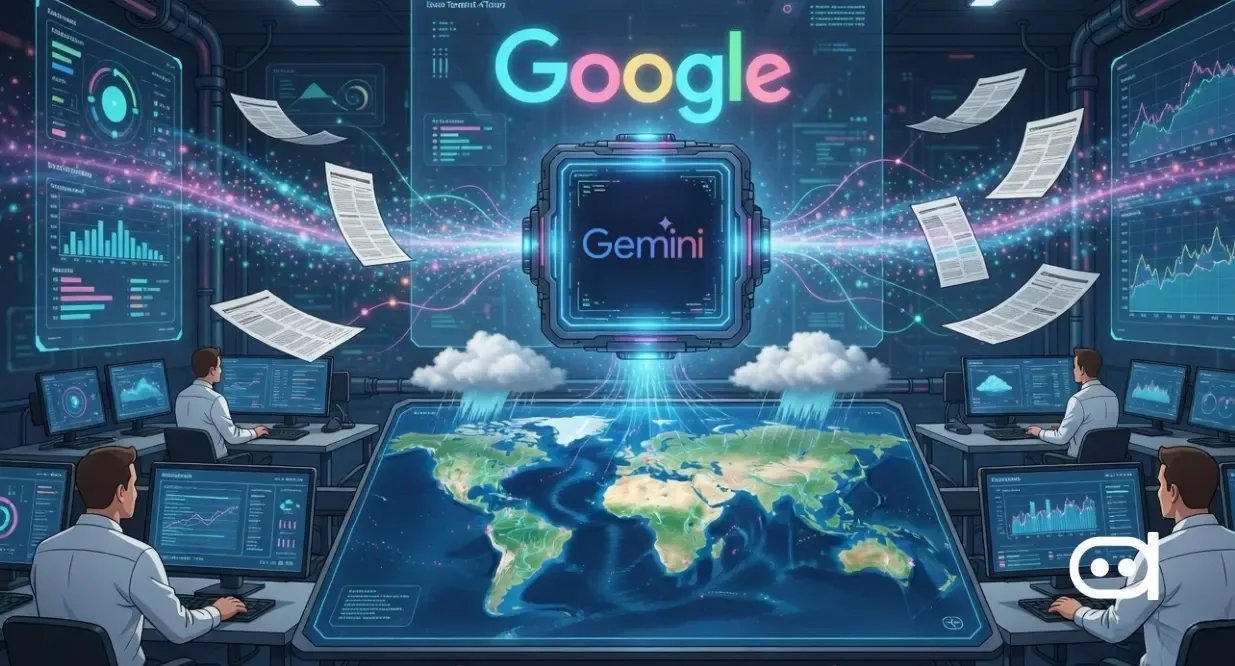
Using Gemini, Google’s large language model, researchers processed five million news articles from around the world. The model was trained to identify flood reports, extract location and timing information, and structure the results into a geo-tagged dataset. What emerged is called Groundsource — a record of 2.6 million flood events, built entirely from written media rather than physical instruments.
Think of it like this: imagine asking a historian to read every local newspaper from every country over the past 30 years and mark every time someone reported a flood, where it happened, and when. Gemini essentially did that — at machine speed and global scale.
What Groundsource Actually Built
The dataset wasn’t the end product. Google’s researchers used Groundsource to train a separate forecasting model built on a Long Short-Term Memory (LSTM) neural network — an architecture well-suited to time-series prediction. That model takes global weather forecast data as its input and outputs a flash flood probability score for a given region.
That system now runs live on Google’s Flood Hub, covering urban risk zones across 150 countries. Critically, its outputs are being shared directly with emergency response organisations on the ground. António José Beleza, an emergency response official at the Southern African Development Community who trialled the system, said it helped his organisation respond to floods faster — a meaningful validation that this isn’t just a research paper result.
A Transparent Look at What the Model Can’t Do
Google has been unusually candid about the system’s limitations, and that honesty is worth matching here.
The forecasting resolution sits at 20 square kilometres. For context, that’s relatively coarse — national weather agencies routinely work at much finer scales. More importantly, the model doesn’t yet incorporate local radar data. Radar is what lets agencies like the US National Weather Service track real-time precipitation and issue precise, street-level alerts. Without it, you have a useful early-warning signal, not a precision emergency system.
That distinction matters enormously in dense urban areas, where the difference between a 2-hour and a 6-hour warning can determine whether evacuation is even possible. For now, this tool is best understood as a meaningful upgrade for regions where the current alternative is no forecast at all — not as a replacement for well-funded national meteorological infrastructure.
| Feature | Google’s Flood Hub Model | Traditional National Weather Systems |
|---|---|---|
| Data Source | News articles + weather forecasts | Physical sensors, radar, satellites |
| Geographic Coverage | 150 countries | Typically national or regional |
| Spatial Resolution | ~20 square kilometres | Sub-kilometre in advanced systems |
| Real-Time Radar | Not yet integrated | Core component |
| Infrastructure Cost | Low — no sensors required | High — requires physical networks |
| Best Use Case | Low-resource, data-scarce regions | High-density urban areas with infrastructure |
The Bigger Signal: Turning Text Into Scientific Data
Here’s what I think deserves more attention than the flood forecasting itself: the method. This is the first known case of Google using a large language model to generate a structured, quantitative scientific dataset from unstructured qualitative text — at this scale and with this level of geographic specificity.
That’s a genuine methodological shift. Climate science, epidemiology, economic history, disaster risk research — all of these fields have enormous bodies of written knowledge locked inside documents, reports, and journalism that have never been machine-readable in any useful sense. Groundsource is a proof of concept that LLMs can unlock that information and turn it into training data.
Marshall Moutenot, CEO of Upstream Tech and co-founder of dynamical.org — a group curating machine-learning-ready weather datasets — described the approach as “creative,” which in scientific understatement means genuinely novel and worth replicating.
What Comes Next — and Why It Matters
Google’s Resilience team has already signalled that the same approach will be applied to other high-stakes, data-scarce phenomena. Heat waves and mudslides were specifically named. Both share the same structural problem as flash floods: they’re localised, fast-moving, and historically under-recorded in machine-readable formats.
Over the next 12 to 24 months, I’d expect to see this LLM-to-dataset pipeline appear across multiple climate and public health applications — not just inside Google, but adopted by universities, NGOs, and government agencies who suddenly have a replicable method for squeezing structured intelligence out of archived text. The constraint has never been the absence of historical knowledge. It’s been the inability to process it. That barrier just got significantly lower.
If you care about how AI is reshaping the physical world — not just the digital one — the Groundsource project is one of the most practically significant things Google has published this year. I’ll be tracking closely how this methodology scales beyond floods, because the implications reach far beyond weather forecasting. When AI can transform decades of human-written knowledge into actionable scientific data, the ripple effects will touch every field where good data has historically been too expensive or too fragmented to collect. That’s most of them.