
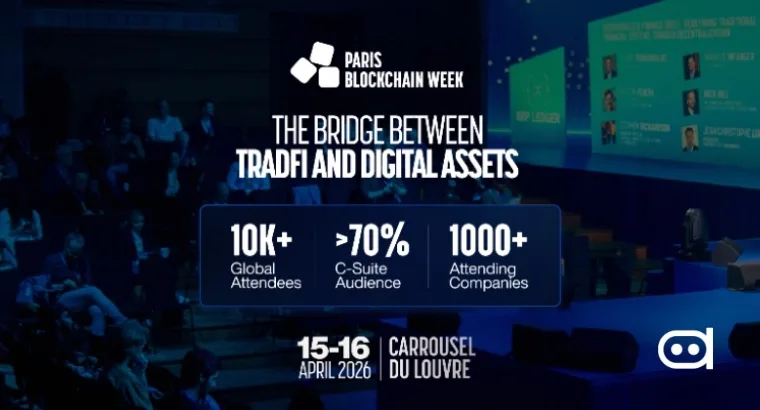
Something quietly significant is happening in how the world’s largest financial institutions are talking about blockchain — and Paris Blockchain Week 2026 may be the clearest evidence yet that the conversation has fundamentally changed. This isn’t a crypto conference in the traditional sense. It’s a gathering where the people who run capital markets, write financial regulation, and manage trillions in assets are sitting down with blockchain infrastructure builders — not to debate whether digital assets matter, but to figure out exactly how they fit into the systems that already govern global finance.
From Speculation to Institutional Infrastructure
For most of blockchain’s short history, the conferences looked the same: developers pitching protocols to other developers, founders promoting tokens to retail investors, and a general atmosphere of disruption-as-religion. That era isn’t entirely over, but Paris Blockchain Week 2026, scheduled for April 15–16 at the Carrousel du Louvre, signals a meaningful departure from it.
The agenda this year is organized around institutional adoption — custody models, tokenization standards, stablecoin frameworks, and enterprise-grade compliance. These are not aspirational topics. They reflect what large financial organizations are actively working through right now, internally and alongside regulators.
When S&P Global, Fidelity Investments, Bank of America, Deutsche Bank, BlackRock, J.P. Morgan, and the European Commission all show up to the same blockchain event, the story stops being about whether institutions will engage with digital assets. It becomes about what that engagement actually looks like in practice.
What the Speaker List Tells Us About Where We Are
The confirmed speaker lineup is worth examining closely, because it tells you more than any press release could. Dr. Nouriel Roubini — once one of blockchain’s most prominent skeptics — is on the program alongside Natasha Cazenave from ESMA, the European body that oversees securities markets. That pairing alone signals a maturity in the conversation that would have been unthinkable five years ago.
Add representatives from Morgan Stanley, Citi, BNY, the London Stock Exchange, Amundi, and Coinbase to the mix, and you have something that looks less like a Web3 rally and more like a cross-sector working group with an audience. These are people who control real capital flows and write real policy. Their presence implies obligations, not just interest.
The topics they’ll address — tokenization, stablecoin regulation, market data infrastructure, custody — are the precise points where traditional finance and blockchain technology must eventually negotiate shared standards. This is where the actual integration work happens, quietly, far from market headlines.
Why Europe, and Why Paris Specifically
Europe is arguably the most important jurisdiction for understanding how regulated digital asset markets will develop globally. The Markets in Crypto-Assets regulation — known as MiCA — represents the world’s most comprehensive legislative framework for digital assets. It creates licensing requirements, consumer protections, and operational standards that no serious institution can ignore if they want to operate in the EU.
Paris sits at the center of this. France has actively positioned itself as a European hub for fintech and digital asset regulation, and its financial regulator, the AMF, has been among the more engaged in Europe on licensing questions. Hosting Paris Blockchain Week at the Carrousel du Louvre, with an invitation-only gathering at the Château de Versailles, is not just aesthetic. It signals the kind of institutional gravitas organizers are deliberately cultivating.
For blockchain-native firms navigating the MiCA landscape, Paris provides direct access to the policymakers shaping the rules. For traditional financial institutions, it offers a neutral forum to benchmark their own approaches against peers — without the competitive pressure of a closed industry meeting.
The Tokenization Question Nobody Can Avoid
If there’s a single concept threading through the entire PBW 2026 agenda, it’s tokenization — the process of representing real-world assets like bonds, equities, real estate, or funds as digital tokens on a blockchain. Think of it like converting a paper property deed into a programmable digital record that can be transferred, fractioned, or used as collateral almost instantly, without the settlement delays that traditional markets still run on.
Major institutions including BlackRock and Franklin Templeton have already launched tokenized fund products. JPMorgan has been running blockchain-based repo transactions through its Onyx platform for years. These aren’t experiments anymore — they’re operational systems handling real transactions at scale.
What Paris Blockchain Week provides is a venue to align on the standards, custody models, and regulatory interpretations that allow these systems to interoperate. Without that alignment, tokenization remains fragmented — innovative within individual institutions but unable to create the network effects that would make it genuinely transformative at a market-wide level.
Key Facts: Paris Blockchain Week 2026 at a Glance
| Detail | Information |
|---|---|
| Dates | April 15–16, 2026 |
| Main Venue | Carrousel du Louvre, Paris |
| VIP Gathering | Château de Versailles (invitation only) |
| Key Institutional Partners | S&P Global, Fidelity, Bank of America, Deutsche Bank, BlackRock, J.P. Morgan |
| Policy Presence | European Commission, ESMA |
| Core Topics | Tokenization, stablecoins, custody, MiCA compliance, market infrastructure |
| Regulatory Context | EU MiCA framework — world’s most comprehensive crypto regulation |
| Audience Focus | Senior decision-makers in finance, regulation, and blockchain infrastructure |
What This Signals for the Next 12–24 Months
Events like Paris Blockchain Week don’t create trends — they reflect ones already forming beneath the surface. The fact that this particular gathering can attract both ESMA’s leadership and Coinbase’s executives to the same stage suggests that the negotiation between decentralized finance and regulated markets is no longer theoretical. It is active, ongoing, and producing real outputs.
Over the next two years, I expect three developments to accelerate directly from the kind of dialogue PBW 2026 facilitates. First, cross-border standards for tokenized asset interoperability — the digital finance equivalent of agreeing on a common electrical plug. Second, clearer custody frameworks that allow institutional asset managers to hold digital assets without the legal ambiguity that has held many back. Third, stablecoin regulation that distinguishes between payment instruments and investment vehicles in ways that traditional securities law was never designed to handle.
None of these developments will happen because of a single conference. But forums where the right people can build trust, compare approaches, and find common language are how complex regulatory and technical alignment actually begins. Paris Blockchain Week 2026 is one of those forums — and its guest list suggests it may become an increasingly important one.
Why This Matters Beyond the Blockchain World
It’s easy to dismiss blockchain conferences as self-referential industry events. Paris Blockchain Week 2026 earns a different kind of attention because the decisions being made in rooms like these will shape how ordinary financial products — pension funds, government bonds, trade finance — are eventually structured and settled. That affects everyone with savings, a mortgage, or a retirement account, whether they’ve ever heard of a blockchain or not.
If you follow AI’s impact on finance, enterprise automation, or regulatory technology, the trajectory being discussed at events like PBW 2026 runs parallel — and will increasingly intersect. The infrastructure being built today for tokenized assets will eventually carry AI-driven financial products, autonomous settlement systems, and programmable compliance tools. These worlds are converging faster than most people outside of specialized finance realize.
If you want to understand where global finance is quietly heading — not in five years of speculation, but in the next eighteen months of actual institutional decisions — keep a close eye on what comes out of Paris this April. The signal-to-noise ratio at PBW 2026 looks unusually high. And in a space normally saturated with noise, that matters.