
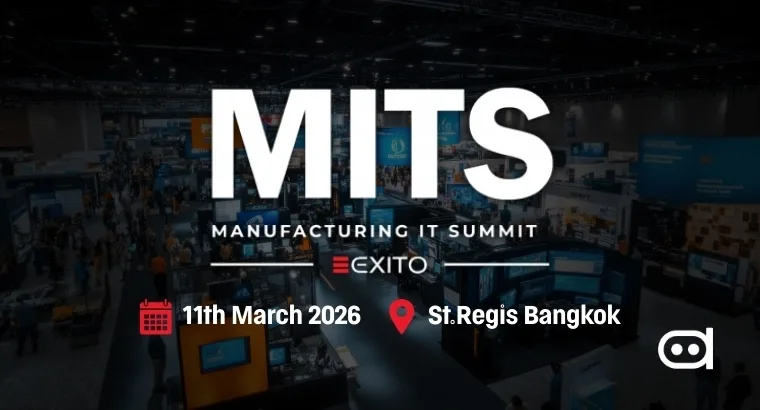
Thailand is quietly becoming one of the most important test cases for AI-driven manufacturing in Southeast Asia — and the conversation happening at the 32nd Manufacturing IT Summit in 2026 reveals exactly why this moment matters. For years, the country built its industrial reputation on automotive and electronics output. Now, it’s betting on artificial intelligence, connected machines, and real-time data to defend that position in a world where cheap labor alone no longer wins.
The Shift That’s Actually Happening on Thai Factory Floors
This isn’t a story about distant tech ambitions written in government white papers. It’s happening now, on actual assembly lines. One of Thailand’s major automotive manufacturers — representative of a broader trend — has already deployed IoT sensors across production systems to monitor equipment in real time, predict failures before they happen, and reduce costly unplanned downtime.
The result isn’t just efficiency. It’s a fundamentally different relationship between humans and machines. Workers aren’t being replaced — they’re being repositioned. Digital upskilling programs are training floor teams to collaborate with automated systems, read data dashboards, and act on AI-generated recommendations rather than gut instinct.
Think of it like the shift from paper maps to GPS navigation. The driver still drives. But the quality of every decision improves because the information layer underneath is dramatically richer.
What Industry 4.0 Actually Means in Plain Language
“Industry 4.0” gets thrown around constantly, but its meaning often gets lost. At its core, it describes the integration of digital intelligence into physical production — sensors that talk to software, software that talks to enterprise systems, and enterprise systems that feed decision-makers with live, actionable data.
In the Thai automotive case, this meant connecting plant-floor machines directly to cloud-based manufacturing execution systems. Leadership could finally see, in one unified platform, what was happening in quality control, logistics, and distribution — simultaneously, in real time. That kind of visibility used to require entire teams of analysts and days of reporting lag. Now it’s a dashboard.
Why Thailand — and Why Now
Thailand has long been Southeast Asia’s manufacturing anchor, particularly in automotive and hard-disk drive production. But regional competition is intensifying. Vietnam, Indonesia, and India are all aggressively courting the same foreign investment. Thailand’s response has been to move up the value chain rather than race to the bottom on cost.
That strategic logic is sound. Manufacturers don’t just want cheap production anymore — they want reliable, smart, data-secure production. Thailand’s infrastructure, regulatory stability, and existing industrial base give it a genuine head start, but only if the digital transformation keeps pace with global expectations.
The Manufacturing IT Summit exists precisely to accelerate that pace — bringing together over 200 CIOs, CTOs, and digital transformation leaders to share implementation frameworks that actually work, not just theory.
The Cybersecurity Problem Nobody Talks About Enough
Here’s the uncomfortable flip side of connecting every machine on a factory floor to the internet: every connected machine is a potential entry point for a cyberattack. This isn’t hypothetical. Industrial facilities have become high-value targets precisely because operational disruption — even briefly shutting down a production line — causes enormous financial damage.
As Thai manufacturers integrate more connected systems, cybersecurity can no longer be treated as an IT department concern. It becomes a production continuity concern, a supply chain concern, and increasingly a national economic concern. Building security into the architecture from day one, rather than bolting it on afterward, is the difference between a resilient smart factory and an expensive vulnerability.
AI’s Specific Role: Quality, Prediction, and Precision
Within the broader Industry 4.0 framework, AI is doing specific, measurable work. AI-driven quality inspection systems on Thai production lines are detecting defects at a level of precision and speed that human inspectors simply cannot match consistently across thousands of units per hour. Advanced robotics guided by machine learning are optimizing throughput without requiring new physical infrastructure.
This is a critical point: AI in manufacturing isn’t primarily about replacing workers — it’s about doing things that were previously impossible at scale. Inspecting every single unit. Predicting a bearing failure three weeks before it happens. Adjusting energy usage in real time based on production load. These are capabilities that compound over time, making each year of operation more efficient than the last.
Key Facts: Thailand’s Smart Manufacturing Landscape
| Area | Current Status / Direction |
|---|---|
| Primary Industries Transforming | Automotive, electronics, hard-disk drives, food processing |
| Key Technologies Deployed | IoT sensors, AI quality inspection, cloud MES, advanced robotics |
| Summit Scale (2026) | 200+ CIOs, CTOs, and digital leaders across manufacturing sectors |
| Workforce Strategy | Digital upskilling for human-machine collaboration |
| Core Risk Factor | Cybersecurity across increasingly connected production environments |
| Competitive Pressure | Vietnam, Indonesia, India competing for same foreign manufacturing investment |
| Strategic Goal | Move up the value chain through intelligence, not just cost reduction |
The Workforce Question Is Bigger Than It Looks
The human dimension of this transformation deserves more attention than it typically gets. Deploying AI systems and smart sensors is the relatively straightforward part — the technology exists, the vendors are ready, the ROI cases are documented. The harder problem is ensuring that the people operating within these environments can actually use them effectively.
Thailand’s manufacturers are investing in digital upskilling not as a PR gesture, but because a smart factory operated by a workforce that doesn’t understand its data is only marginally better than a traditional one. The real competitive advantage comes from workers who can interpret AI recommendations, override them intelligently when context demands it, and continuously improve the systems they work alongside.
What the Next 12–24 Months Will Reveal
The next two years will be a significant proving period for Thailand’s industrial AI ambitions. The manufacturers that invested early in connected infrastructure and data platforms will begin to show compounding returns — lower defect rates, faster production cycles, stronger export competitiveness. Those that delayed will find the gap harder to close as AI capabilities continue to improve rapidly.
More broadly, Thailand’s trajectory will signal something important for emerging markets globally: whether a country can successfully use AI-driven manufacturing as an economic leapfrog strategy, or whether the complexity and cost of transformation creates new dependencies rather than new advantages. The 32nd Manufacturing IT Summit is one of the places where that question gets worked through in real, practical terms — and its conclusions will matter well beyond Thailand’s borders.
If you work in manufacturing, supply chain strategy, or industrial technology — or if you’re simply tracking how AI is reshaping the physical economy — Thailand in 2026 is a conversation worth following closely. The decisions being made on these factory floors today will define industrial competitiveness across Southeast Asia for the next decade. I’d strongly encourage anyone serious about understanding where physical AI is heading next to keep Thailand firmly on their radar.