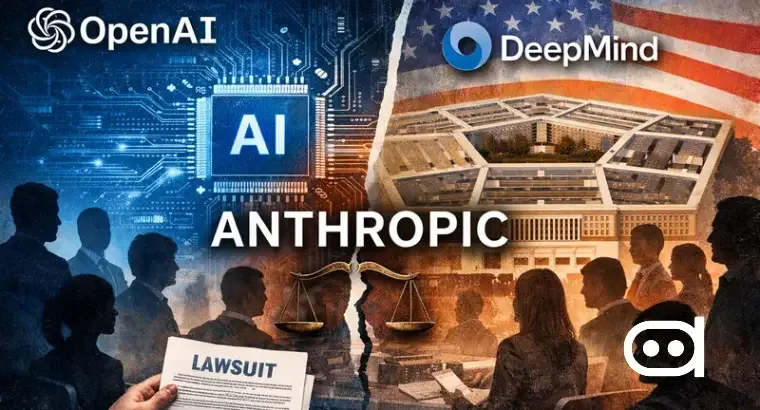
When more than 30 employees from OpenAI and Google DeepMind sign a court brief defending a direct competitor, something genuinely significant is happening — and it goes far beyond a corporate legal dispute. The Anthropic versus Department of Defense lawsuit has quietly become one of the most consequential AI governance battles of this decade, touching on questions that will define how artificial intelligence is developed, deployed, and constrained for years to come.
What Actually Happened Between Anthropic and the Pentagon
The conflict began when Anthropic — the AI safety company behind the Claude family of models — declined to grant the Department of Defense unrestricted access to its AI systems. Specifically, Anthropic reportedly refused to allow its technology to be used for domestic mass surveillance or autonomous weapons deployment without clearly defined guardrails. These weren’t vague objections rooted in corporate caution. They were specific, principled limits written directly into the terms of engagement.
In response, the Pentagon designated Anthropic a “supply-chain risk” — a label typically reserved for foreign adversaries or compromised vendors. That designation is where things escalated dramatically, and why researchers across the broader industry took notice almost immediately.
The Supply-Chain Risk Label Is the Real Story
To understand why this label matters so much, consider an analogy: imagine a construction firm refusing to build a detention facility without adequate ventilation, citing safety regulations — and the government’s response is to blacklist that company from all future federal projects. The punishment doesn’t match the disagreement. It transforms a principled policy difference into a national security threat.
That is essentially the argument the court brief from OpenAI and DeepMind employees advances. They contend the designation was an improper use of governmental authority — one with the potential to ripple outward across the entire AI industry. If companies understand that setting ethical limits on their technology can result in being labeled a security risk, many will simply stop setting limits at all. The chilling effect writes itself.
Jeff Dean and the Weight of Who Signed This Brief
The names attached to this court filing are not junior researchers testing the waters. Jeff Dean — one of the most respected figures in modern computing, co-creator of Google Brain, and a foundational architect of deep learning infrastructure — is among the signatories. When someone of his stature steps into a legal dispute voluntarily, it signals genuine alarm within the technical community, not performative politics.
Over 30 researchers and engineers from two of Anthropic’s direct competitors signed the brief in solidarity. In a fiercely competitive industry where OpenAI, Google DeepMind, and Anthropic are racing for talent, market position, and policy influence simultaneously, this kind of cross-company alignment is almost without precedent. What united them wasn’t loyalty to Anthropic — it was a shared concern about what this case could normalize across the field.
OpenAI Took the Pentagon Deal — But Its Own Employees Pushed Back
While Anthropic held the line, OpenAI moved in a different direction — ultimately securing the contract with the Department of Defense. But that decision wasn’t without significant internal friction. Multiple credible reports indicate that a meaningful portion of OpenAI’s workforce raised concerns internally about deploying their models in defense environments without clearly defined ethical constraints.
This internal tension at OpenAI tells its own story. The most safety-conscious voices inside these companies are not fringe outliers — they represent a substantial, organized faction of the technical workforce. And when those employees observe how the U.S. government treated Anthropic for drawing principled lines, the message they receive is an uncomfortable one: setting limits has real commercial consequences.
The Systemic Chilling Effect on AI Safety Culture
Here is the deeper systemic risk concealed inside this legal dispute: if the U.S. government can penalize an AI company for imposing safety restrictions on its own technology, it creates a perverse incentive structure industry-wide. Companies will face quiet, sustained pressure to offer unconditional access to powerful systems — or risk being sidelined from lucrative government contracts entirely.
The researchers backing Anthropic argue this dynamic could suppress open scientific debate about AI risks at precisely the moment that debate is most needed. When the commercial consequences of raising concerns become severe enough, fewer people raise concerns. That is not a healthy environment for a technology advancing as rapidly as large language models and autonomous systems currently are. Silence gets institutionalized, and institutionalized silence is how preventable failures happen.
| Key Element | Detail |
|---|---|
| Dispute Origin | Anthropic refused DoD unrestricted access to its AI models |
| Pentagon’s Response | Designated Anthropic a “supply-chain risk” |
| Anthropic’s Legal Action | Filed lawsuits against DoD and relevant federal agencies |
| Signatories Supporting Anthropic | 30+ employees from OpenAI and Google DeepMind |
| Notable Signatory | Jeff Dean, co-creator of Google Brain |
| Core Argument in Brief | Government misused authority; ruling could harm entire AI sector |
| OpenAI’s Position | Secured DoD contract; internal employees reportedly protested |
| Proposed Alternative | DoD could have simply canceled contract and selected another vendor |
What the Government’s Argument Actually Reveals
Defense officials argued that the government should be able to use AI systems for any lawful purpose, without restrictions imposed by private contractors. On the surface, that position sounds entirely reasonable — sovereign governments deploying technology they’ve procured seems unremarkable. But it ignores a fundamental reality about how modern AI systems actually function.
Unlike traditional software with discrete, auditable commands, a large language model doesn’t come with a simple toggle switch for harmful applications. The engineers who build these systems understand their failure modes, edge cases, and potential for misuse more deeply than any external operator. Restricting deployment isn’t obstruction or corporate overreach — it’s informed engineering judgment exercised responsibly. Stripping that judgment away doesn’t make AI safer in government hands. It makes it considerably more dangerous in the hands of people who haven’t spent years studying its failure modes.
What This Signals for the Next 12 to 24 Months
This case is almost certainly a preview of a much larger confrontation that is still forming. As AI systems grow more capable — particularly in agentic configurations where models take autonomous action across digital environments — the tension between government demand for unfettered access and industry-led safety standards will intensify considerably. I expect we will see more lawsuits, more organized internal protests at major AI companies, and eventually some form of federal legislation attempting to define the rules of engagement between AI developers and government agencies.
The Anthropic case may also accelerate serious calls for an independent AI oversight body — a neutral authority capable of adjudicating disputes like this one without leaving resolution to courts largely unfamiliar with the technical nuances involved. Countries within the European Union are already moving in this direction through the EU AI Act’s enforcement mechanisms. Whether the United States follows will depend partly on how politically contentious cases like this one ultimately resolve, and whether Congress treats them as isolated incidents or structural warnings.
If you care about where AI is genuinely heading — not just as a technology but as a force actively reshaping law, public policy, and the boundaries of corporate responsibility — this is among the most important stories to follow closely through the remainder of 2025. I’ll be tracking every significant development as it emerges. For deeper context, explore the related analysis on AI governance and enterprise automation across this site. The legal complexity here is real, but don’t let it obscure what’s actually at stake: the question of who gets to decide how the most powerful tools ever built are used, and what happens when that answer becomes commercially inconvenient.