
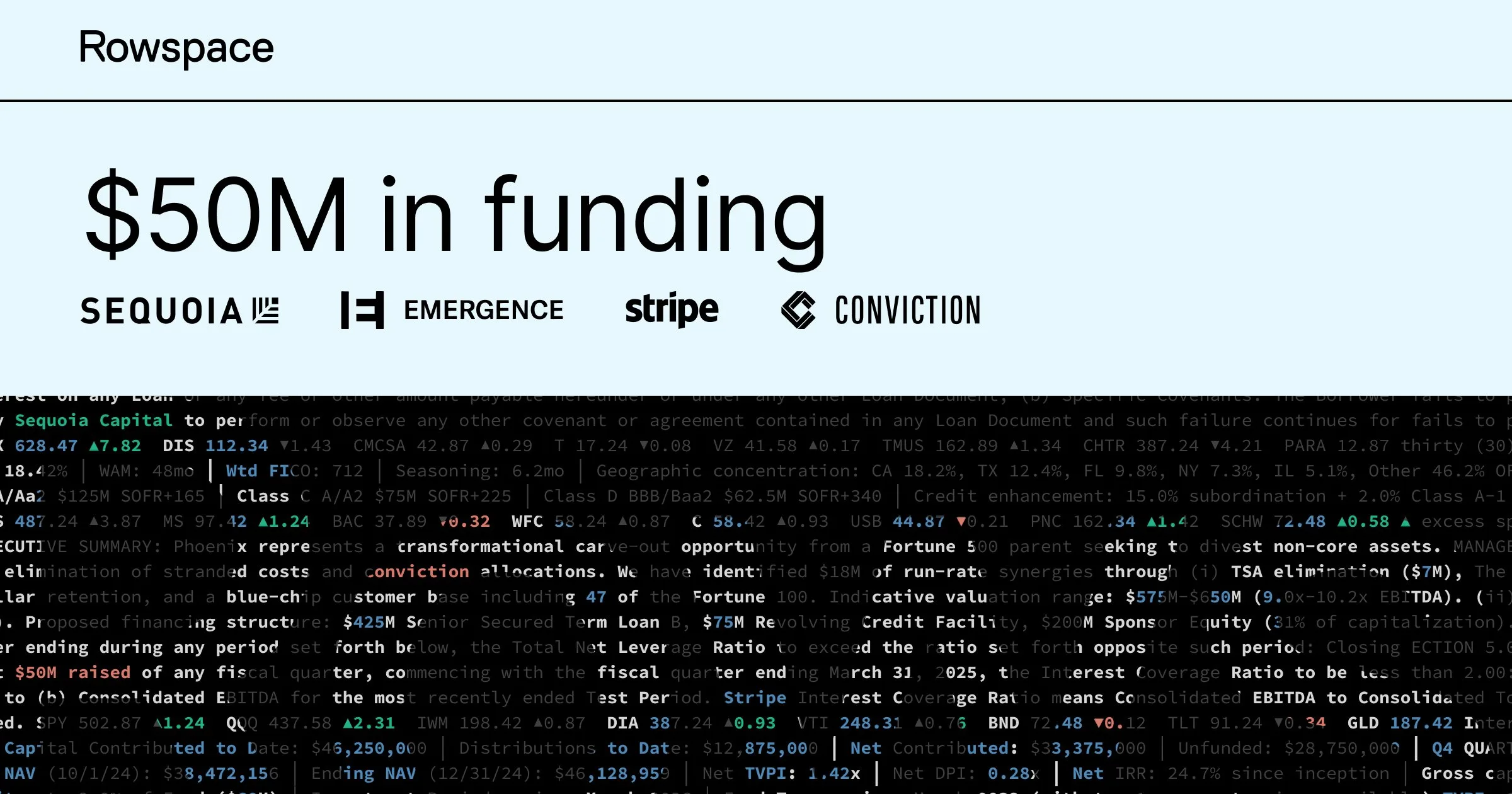
The dirty secret of private equity is that some of the most valuable intelligence in the world is completely inaccessible — buried in decade-old deal memos, scattered PowerPoint decks, and the personal notebooks of partners who may have already retired. Every time a new deal lands on an analyst’s desk, that accumulated wisdom is essentially invisible. A San Francisco startup called Rowspace just raised $50 million to fix that, and the way it’s doing so tells us something important about where enterprise AI is actually headed.
Why Private Equity Has an Institutional Memory Problem
Private equity firms make extraordinarily consequential financial decisions — often involving hundreds of millions of dollars — but they operate with surprisingly fragmented information systems. Deal databases don’t talk to accounting platforms. Internal memos live in email threads. Underwriting assumptions from 2014 sit in spreadsheets that nobody remembers exist.
What this means in practice is that analysts routinely start from scratch on due diligence, even when their own firm has already answered the same question before. It’s the equivalent of a hospital with no patient records — experienced, skilled professionals operating without the benefit of institutional history. The cost isn’t just efficiency. It’s decision quality.
What Rowspace Actually Built
Rowspace connects structured and unstructured data from across a firm’s entire operational history — investment systems, document repositories, old presentations, deal memos, accounting records — and applies what co-founder Michael Manapat calls a “finance-native lens.” That phrase matters. It means the AI doesn’t just retrieve information; it interprets it the way the firm itself would, reflecting how that specific institution reconciles conflicting data and weighs decisions.
Everything runs inside the client’s own cloud environment. The firm’s proprietary data never touches Rowspace’s servers, which is a non-negotiable requirement for institutions managing hundreds of billions in assets. The interface surfaces through Excel, Microsoft Teams, or the platform’s own dashboard — wherever analysts already live.
The Founders Who Could Actually Pull This Off
The founding team is unusually well-suited to this specific problem. Michael Manapat built machine learning infrastructure at Stripe — systems that process billions of transactions — before serving as CTO at Notion during its AI expansion. His co-founder Yibo Ling is a two-time CFO who ran finance teams at Uber and Binance. Ling tested early ChatGPT models on real due diligence work and ran directly into the wall that defines this problem: the AI had capability, but no context.
“You need the right information in the right context,” Ling told Fortune. That insight, simple as it sounds, is the entire architectural philosophy of Rowspace. General-purpose AI fails in finance not because it’s unintelligent, but because it has no access to the institution-specific patterns that make financial judgment possible.
A $50M Bet Backed by Sequoia and Stripe
The funding round — a seed led by Sequoia followed by a Series A co-led by Sequoia and Emergence Capital — also included participation from Stripe, Conviction, Basis Set, and Twine. The investor list is deliberately strategic. Stripe’s involvement signals confidence from a company that understands financial infrastructure at scale. Emergence Capital has a track record of backing enterprise software that becomes embedded in how professional firms operate.
What’s notable is that the company launched publicly with roughly ten top-tier private equity and credit firms already paying seven-figure annual contract values. These aren’t pilots. These are firms managing assets from hundreds of billions to nearly a trillion dollars, already relying on Rowspace as a live operational tool.
Quick Reference: Rowspace at a Glance
| Detail | Information |
|---|---|
| Total Funding Raised | $50 million (Seed + Series A) |
| Lead Investors | Sequoia Capital, Emergence Capital |
| Notable Participants | Stripe, Conviction, Basis Set, Twine |
| Co-Founders | Michael Manapat (ex-Stripe, Notion CTO), Yibo Ling (ex-Uber, Binance CFO) |
| Core Use Case | Institutional memory + AI-assisted due diligence for PE firms |
| Data Security Model | Runs inside client’s own cloud environment |
| Current Customers | ~10 firms managing hundreds of billions to ~$1 trillion in assets |
| Contract Values | Seven-figure annual deals |
Why This Is About More Than Efficiency
It’s tempting to frame Rowspace as a productivity tool — something that helps analysts work faster. But the more significant implication is about the quality of decisions, not the speed of making them. When a junior analyst can surface a decade of comparable transactions and internal underwriting logic in minutes, the knowledge gap between a first-year hire and a 20-year partner begins to narrow.
Think of it like the difference between a law firm with no case precedent system and one with a fully searchable, contextually intelligent legal library. The second firm doesn’t just work faster — it reasons better. In private equity, where a single misjudged deal can cost hundreds of millions, that distinction is the entire business case.
The Larger Signal: Finance AI Is Growing Up
Rowspace’s launch fits into a broader maturation happening across enterprise AI. Early financial AI tools were mostly about automation — processing faster, reducing manual data entry. The current wave is fundamentally different. It’s about encoding institutional judgment: capturing not just data, but the interpretive logic that makes data meaningful within a specific organization.
This shift from automation to institutional cognition is arguably the most important transition in enterprise software right now. And finance, with its high stakes, proprietary data, and deeply fragmented systems, is where the pressure to get this right is most intense. Firms that build genuine AI fluency into their investment process over the next 12 to 24 months won’t just operate more efficiently — they’ll develop a compounding analytical advantage that becomes harder to replicate over time.
What Comes Next for Institutional AI
Over the next two years, I expect we’ll see Rowspace expand beyond due diligence into portfolio monitoring — using the same institutional memory framework to flag when a current investment is tracking toward patterns that preceded problems in past deals. That’s the natural extension of what they’ve built. The firms that adopt this kind of AI early aren’t just buying software. They’re building a second brain that gets smarter with every decision the firm makes.
There’s also a broader precedent being set here that extends well beyond finance. Law firms carry the same institutional amnesia problem. Hospital systems lose clinical reasoning every time a senior physician retires. Consulting firms rebuild frameworks that already exist somewhere in a forgotten shared drive. The architecture Rowspace is applying to private equity is a template that will migrate across every high-stakes professional industry where judgment — not just data processing — is the core product.
The Compounding Advantage Most Firms Will Miss
What strikes me most about Rowspace isn’t the technology itself — it’s the timing. We’re at the precise moment when AI has become capable enough to encode institutional reasoning, but most organizations haven’t yet recognized that window. The firms moving now will accumulate years of machine-learned context before competitors even start the conversation internally. That’s not a marginal advantage. In finance, compounding logic applies to information advantages just as powerfully as it applies to capital.
If you’re curious about how AI is quietly transforming the way professional institutions make high-stakes decisions — from finance to healthcare to law — this is exactly the kind of development worth watching closely. I’ll be covering more of these enterprise AI stories as they emerge, because the most consequential shifts in artificial intelligence aren’t always announced with the loudest headlines. Sometimes they arrive as a quiet infrastructure upgrade that reshapes how entire industries think.