
The dirty secret of enterprise AI is that most of it never leaves the lab. Companies spend months building impressive pilots, only to watch them stall somewhere between “proof of concept” and “actual production system.” A new initiative from NTT DATA and NVIDIA is directly targeting that gap — and the way they’re doing it tells us a lot about where enterprise AI is heading in the next two years.
The Pilot-to-Production Problem Is More Common Than Anyone Admits
Ask any chief technology officer at a mid-to-large enterprise about their AI journey, and you’ll likely hear the same frustrated story. A team builds something impressive in a controlled environment. It works beautifully in the demo. Then comes the hard part: deploying it at scale, inside real infrastructure, with real governance requirements, real security constraints, and real financial accountability.
This is the moment most AI projects quietly die. It’s not a technology failure — it’s a systems failure. The tools that help you build an AI model are rarely the same tools that help you run it reliably at scale across an organization. That gap has cost enterprises billions in wasted AI spending.
NTT DATA is calling their answer to this problem an “enterprise AI factory.” The framing is intentional and worth unpacking.
What an AI Factory Actually Means in Practice
The factory metaphor isn’t just marketing. A traditional factory takes raw inputs, runs them through a standardized process, and produces consistent, repeatable outputs. NTT DATA is applying that same logic to AI deployment — creating a structured, repeatable model that takes an organization’s specific needs and runs them through a governed, production-ready infrastructure.
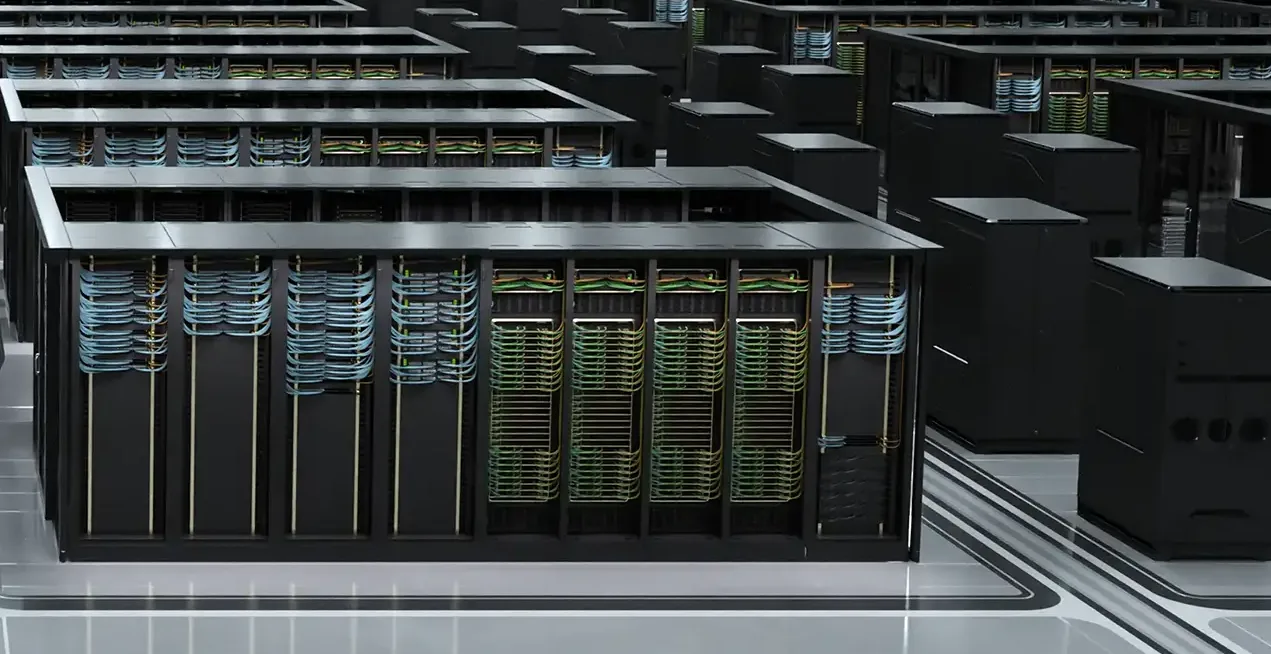
The underlying hardware is NVIDIA’s GPU-accelerated computing stack, combined with high-performance networking. On top of that sits NVIDIA AI Enterprise software, specifically two components called NeMo and NIM Microservices. Think of NeMo as the workshop where agentic AI systems are designed and trained, and NIM as the pre-packaged shipping containers that get those systems deployed quickly into real applications.
Together, the stack is designed to cover the full AI lifecycle — from model training all the way through to live enterprise deployment — inside a single governed framework. That governance layer is not a minor detail. It’s arguably the most important part for any organization that has to answer to regulators, auditors, or a board of directors.
Three Real-World Deployments That Show What’s Actually Working
Abstract architecture diagrams only go so far. What makes this announcement credible is the early-adopter evidence. A leading cancer research hospital is already using this infrastructure — built on NVIDIA HGX platforms in collaboration with NTT DATA and Dell — to run advanced radiology analysis and accelerate clinical research workflows. That’s not a chatbot experiment. That’s high-stakes medical AI running in production.
In automotive manufacturing, a global supplier used the AI factory model to validate production workloads on bare metal infrastructure before scaling. The result was a measurable reduction in production setup time — the kind of outcome that finance teams can actually see on a balance sheet.
A third deployment involves a US-based technology manufacturer using NVIDIA-accelerated simulation and 3D visualization to virtually validate an entire battery production line before a single physical component was installed. That last example deserves particular attention — it represents what’s often called “digital twin” methodology, and it signals that AI is no longer just a software story. It’s becoming a physical infrastructure story too.
Key Technical Components of the NTT DATA AI Factory Stack
| Component | What It Does | Why It Matters |
|---|---|---|
| NVIDIA NeMo | Suite for building and training agentic AI systems on GPU infrastructure | Enables domain-specific model development at scale |
| NVIDIA NIM Microservices | Pre-built, GPU-optimized containers with deployment APIs | Drastically reduces time from development to live deployment |
| NVIDIA HGX Platforms | High-performance GPU compute hardware | Powers compute-intensive workloads like radiology AI and simulation |
| AI Enterprise Software Layer | Governance, security, and lifecycle management framework | Meets compliance and auditability requirements in regulated industries |
| GenAI Pre-Qualified Prototypes | Pre-built sector-specific application templates | Reduces complexity and accelerates time-to-value for clients |
| Cloud + Edge Deployment | Flexible architecture across centralized and distributed environments | Supports diverse enterprise infrastructure configurations |
Why Governance Is Now the Competitive Battleground for Enterprise AI
Eighteen months ago, enterprise AI conversations were dominated by capability questions: What can the model do? How accurate is it? Today, the questions that actually close deals are different: Who is accountable when it gets something wrong? How does it integrate with existing compliance frameworks? Can we audit its decisions?
The shift reflects real pressure. Boards, regulators, and shareholders are now scrutinizing AI spending with a demand for measurable returns. The era of “we’re experimenting with AI” as a sufficient answer is ending. Organizations need to show what their AI investments actually produced — in revenue saved, costs reduced, or risk avoided.
The AI factory model is, at its core, a governance play dressed as an infrastructure play. By standardizing the process of building and deploying AI, it creates an auditable trail. That’s not exciting in a demo. But it’s what makes enterprise AI viable at scale in any regulated industry.
The Larger Trend: Agentic AI Needs Industrial Infrastructure
This announcement sits squarely within one of the most significant transitions in AI right now — the shift from AI as a tool to AI as an autonomous agent. Agentic AI systems don’t just respond to queries. They plan, reason, take sequences of actions, and operate with a degree of independence inside enterprise workflows.
That kind of AI requires a fundamentally different infrastructure model than what was built for earlier generations of machine learning or even large language models. It needs reliable orchestration, real-time compute, and robust guardrails — all at the same time. The AI factory architecture is an attempt to provide exactly that in a form that organizations can actually operate without a team of PhD researchers on staff.
NTT DATA’s positioning as the only global IT services provider active across all three of NVIDIA’s partner tracks — Solution Provider, Cloud Partner, and Global System Integrator — gives them an unusual degree of leverage in this space. It means they can serve clients from initial infrastructure procurement through to ongoing operations, without handoffs to third parties at critical junctures.
What the Next 12–24 Months Look Like
The AI factory model will likely become the dominant enterprise AI deployment pattern by 2027. The alternative — custom-built, one-off AI deployments that require specialist teams to maintain — is simply not scalable for most organizations. Standardization is how every technology wave eventually matures, and enterprise AI is no different.
We should expect to see other global IT services firms respond with competing frameworks. The differentiation will increasingly come not from the AI models themselves — those are commoditizing rapidly — but from the quality of the governance layer, the depth of domain-specific customization, and the ability to demonstrate financial returns in a way that satisfies a CFO, not just a CTO.
The three early deployments NTT DATA has shared — healthcare, automotive, battery manufacturing — are not coincidental choices. They represent sectors where AI errors carry serious consequences, where regulatory scrutiny is high, and where the financial stakes of getting deployment right are enormous. Succeeding in those environments is the proof of concept that the rest of the enterprise world is watching for.
If you’re thinking seriously about where AI infrastructure is heading — whether you work in technology, finance, or any sector navigating an AI investment decision — this development is worth tracking closely. The shift from AI experimentation to AI production is the defining enterprise technology story of the next two years. Explore more analysis on how agentic AI and enterprise automation are reshaping industries across our site, and consider how these same infrastructure principles might apply to the AI investments happening in your own field.